
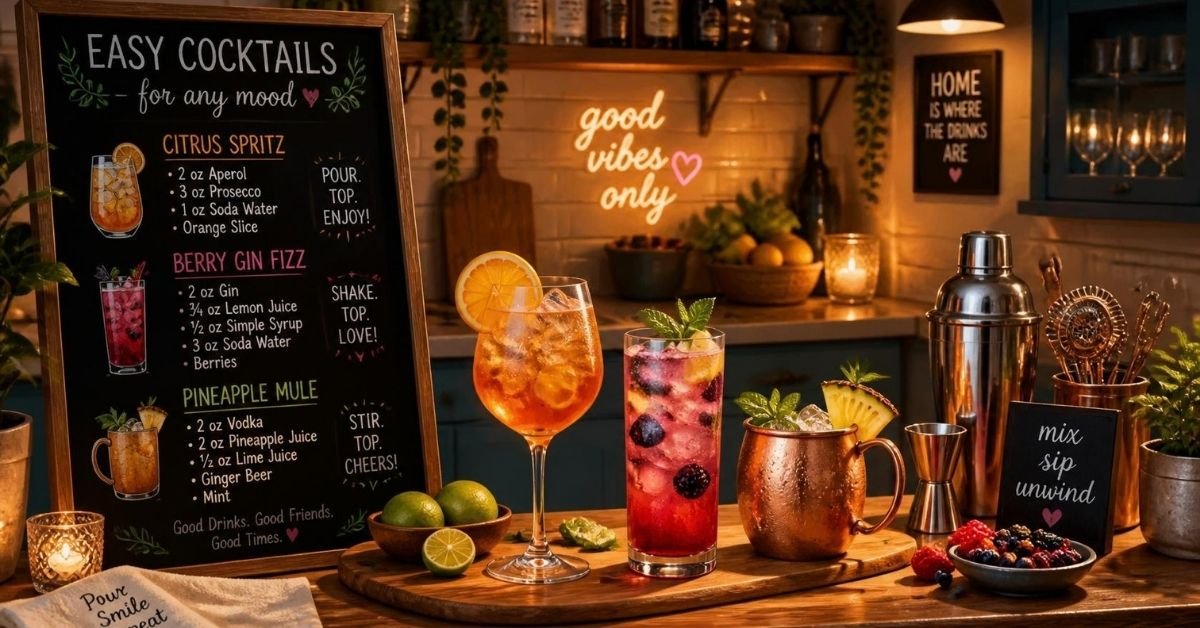
Most pages that promise easy cocktail recipes hand you a grid of names, photos and “5 mins” tags — and nothing you can actually use. No measurements. No method. No note on what glass, what ice, or what to do when the drink tastes wrong. You close the tab still unable to make anything.
This guide works the other way around. It starts by defining what “easy” really means, then gives you a formula you can memorise, a short list of drinks worth learning first, and the practical support — substitutions, scaling, alcohol-free versions and troubleshooting — that turns a recipe into something you can pour tonight.
You don’t need a full bar or specialist equipment. A bottle or two, fresh citrus, ice and a glass will do. And since plenty of classics are genuinely strong, treating pacing, food and water as part of the plan is simply part of making drinks well.
What Makes a Cocktail Recipe Easy
A cocktail is easy when it passes five tests: few ingredients, no advanced technique, little or no specialist equipment, a few minutes of work, and ingredients you can actually buy nearby.
That’s the whole definition, and you can apply it to any recipe you come across — not just the ones here.
| Criterion | What “easy” looks like | Why it matters |
|---|---|---|
| Ingredient count | Two to four components | Fewer bottles to buy, less to get wrong |
| Technique | Built in the glass, or shaken and strained | Nothing advanced to learn first |
| Equipment | A shaker at most; often just a glass and a spoon | Removes the “I don’t have the kit” barrier |
| Prep time | A few minutes of hands-on work | Fits a weeknight, not just a weekend project |
| Ingredient availability | Supermarket and pantry staples | A recipe isn’t easy if you can’t find half of it |
Few ingredients, simple techniques, short prep time
Ingredient count is the strongest single signal. Many classics use three ingredients or fewer, which is why they’ve survived so long: there’s very little to hide behind. When a recipe needs eight bottles, several of them obscure, the drink may be excellent — but it isn’t easy.
Prep time is the next thing people look at, and it’s worth understanding what those tags actually mean. Large collection pages commonly label their entries at around five minutes, with a handful stretching to ten or fifteen. That’s a useful shorthand, but it’s a publisher’s convention rather than a measured fact, and different sites apply it differently.
The same caution applies to difficulty labels and star ratings. When a whole collection is tagged “Easy,” the label is describing the collection, not verifying each recipe. Star ratings can also rest on a very small number of reviews, so treat them as a prompt to read the method, not as proof of quality.
Technique is the criterion beginners underestimate. A drink built in the glass — spirit, mixer, ice, stir — asks nothing of you. A shaken drink asks you to combine ingredients with ice and strain them, which is a skill worth having but not one you need on day one. Start with the built drinks, add shaking when you’re ready.
Why fresh citrus and good ice matter more than expensive bottles
Two cheap things separate a decent home drink from a disappointing one: fresh citrus and properly cold, decent ice. Squeeze the lemon or lime yourself rather than pouring from a bottle of juice, and chill everything before it goes in the glass.
Chilling does more than make a drink pleasant to hold. Shaking with ice and building over ice both add water, and that water is part of the finished drink rather than a mistake — it’s what softens the alcohol and opens up the flavours. If your ice is wet, half-melted or tastes of the freezer, your drink inherits all of it.
Ice quality is the one place where a little effort pays off. The small-cooler method is the usual home technique: freeze water in a small cooler so it sets as a single block, then break that block into cubes.
It takes longer than a tray, and how long depends entirely on your freezer, so start it well ahead if you want it for a specific evening. A batch of simple syrup and a bowl of fresh-cut citrus in the fridge do the rest.
The Simple Formula Behind Most Easy Cocktails
Two ideas cover most of what you’ll ever want to make. Learn them and you stop needing a recipe to start a drink — you need one only to check a detail.
3-2-1 rule for sour-style drinks
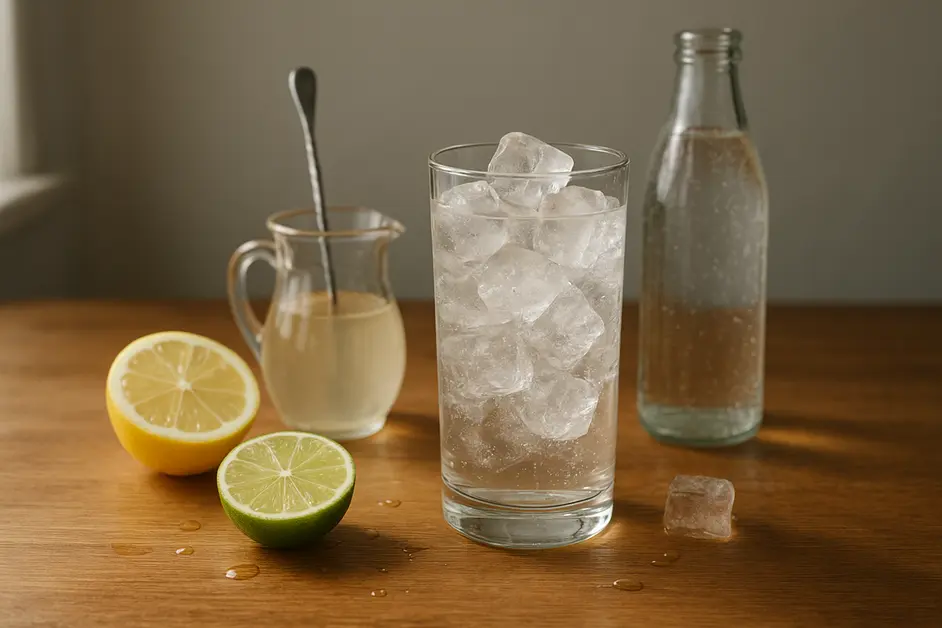
The 3-2-1 rule is a memory device for sour-style drinks: roughly three parts base spirit, two parts citrus and one part sweetener. Use it as a starting point you adjust to taste, not a fixed law.
A sour is simply spirit, acid and sweetener, and the numbers make the proportions easy to carry around in your head. The balance shifts depending on what you’re using — a barrel-aged spirit stands up to more sweetness than a delicate one, lemons vary in sharpness from week to week, and maple syrup or a liqueur sweetens differently from simple syrup. Taste as you go and nudge.
Spirit plus mixer: the two-ingredient starting point
The simplest structure of all is a spirit and a mixer over ice: gin and tonic, rum and cola, whiskey and ginger ale, vodka and tonic, tequila and grapefruit soda. Two ingredients, one glass, no tools, and it’s ready in the time it takes to fill the glass.
These easy mixed drinks are also the most forgiving. Pour the spirit first, add ice, top with the mixer, stir once, and taste. If it’s too strong, add more mixer. If it’s too sweet, squeeze in citrus.
What each part does
- Base spirit — the backbone; swapping it changes the drink’s whole family
- Sour or acid — usually fresh citrus; keeps the drink from tasting flat or syrupy
- Sweetener — simple syrup, honey, maple or a liqueur; rounds off the edges
- Lengthener — soda, seltzer, ginger beer or sparkling wine; stretches the drink and lightens it
Once you see drinks in these four roles, substitutions stop feeling risky. Swap the spirit and you move from a rum sour to a whiskey sour. Swap the citrus and the accent changes. Swap the sweetener and the texture and depth change with it.
The same structure makes lower-alcohol versions straightforward, because you’re only reducing or removing one component rather than rewriting a recipe. More on that below.
A Beginner’s Kit: What You Actually Need
A glass, a spoon and a fridge that genuinely chills things will get you started. Everything else on the list is either useful or optional, and it’s worth knowing which is which before you buy anything.
| Item | Needed? | Notes |
|---|---|---|
| Shaker | Useful | Only essential for shaken drinks; built drinks skip it entirely |
| Strainer | Usually included | Comes with most shakers; used with shaken drinks |
| Mixing glass | Optional | A sturdy jug does the job for stirred drinks |
| Measuring tool | Recommended | Keeps your first few drinks consistent |
| Muddler | Optional | A wooden spoon works in its place |
| Long spoon | Useful | For stirring tall drinks without disturbing the fizz |
| Highball or Collins glass | Yes | Covers most fizzy, tall drinks |
| Lowball or Old Fashioned glass | Yes | Covers spirit-forward, short drinks |
| Ice | Yes | The single most underrated item in the kit |
Spirits that cover most classic cocktails
Bourbon, gin, rum, tequila and vodka. Guides commonly group these as the “big five” and estimate they cover the large majority of classic recipes — one frequently quoted figure is around 70 percent. Treat that as a useful rule of thumb rather than a measured statistic.
The practical point matters more than the number: buy only what the drinks you actually plan to make require. If you’re making a whiskey sour this week, you need whiskey, lemons and sugar. You don’t need five bottles, and stocking a whole bar before your first drink is the most common way beginners spend money and still make nothing.
Storage deserves a sentence, because it affects what’s worth keeping. Vermouth keeps noticeably longer in the refrigerator than fresh juices or homemade syrups. Simple syrup is worth making in a large batch, and it keeps for weeks in the fridge — check it before relying on it, and if you want an exact shelf life for your own batch, verify it rather than guessing.
Shaker, strainer, mixing glass and what you can skip
If you don’t own a shaker yet, don’t buy one first. Start with the drinks you build directly in the glass — there are plenty — and add shaking later, when a sour-style drink makes you want one.
A mixing glass is genuinely optional. You only need it for stirred, spirit-forward drinks, and a jug does the same job. A muddler is the same story: a wooden spoon presses herbs and fruit perfectly well, and not every drink needs muddling in the first place. Measuring is the one place to be fussy early on, because consistent proportions are what make a drink repeatable.
Glassware basics: highball, Collins and lowball
Two shapes cover almost everything here. A highball or Collins glass — tall and narrow — suits fizzy, long drinks. A lowball or Old Fashioned glass — short and wide — suits spirit-forward drinks served over a single large cube. Specialty glassware is optional; it changes how a drink looks, not how it tastes.
Ice is the exception. If you’re going to invest care anywhere, invest it here. Chill your glasses, use fresh ice rather than the remnants of last week’s tray, and keep the small-cooler technique in mind when you want clearer, slower-melting cubes for a spirit-forward drink.
Easy Classics Worth Learning First
Learn two drinks and you’ve learned two techniques. From there, the rest of the classic cocktails for beginners are variations on what you already know.
Whiskey Sour, step by step
The Whiskey Sour is the best first shaken drink: three ingredients, one technique, and a result that tastes like a real cocktail rather than a compromise.
Ingredients: whiskey, fresh lemon juice, simple syrup.
Ratio: roughly two parts whiskey to one part fresh lemon juice, with about three-quarters to one part simple syrup. It’s close cousins with the 3-2-1 rule you met earlier — same family of proportions, a slightly different balance.
Method:
- Combine the whiskey, fresh lemon juice and simple syrup in a shaker with ice.
- Shake well, until everything is combined and properly chilled.
- Strain into a lowball or Old Fashioned glass.
- Garnish with a strip of orange peel and a cocktail cherry.
Expect it to take about five minutes and to make one drink. Two notes worth knowing: maple syrup can stand in for simple syrup and adds a little extra depth, and the orange peel isn’t decoration. Citrus oils sit in the skin, so twist the peel over the glass before you drop it in.
Summer Sunset and other built-in-the-glass drinks
The Summer Sunset is the classic no-shaker drink, and it’s a good reminder that “easy” and “interesting” aren’t opposites.
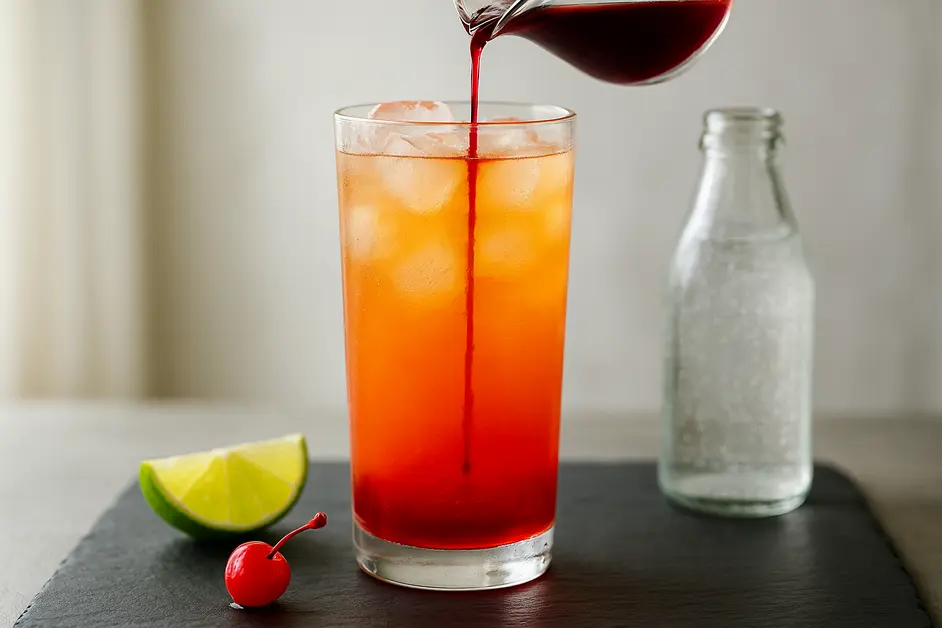
Ingredients: vodka, orange juice, grenadine and lime-flavoured seltzer water, with an optional lime slice and maraschino cherry to finish.
Method: build everything directly in a highball or Collins glass. No shaker, no straining. Pour the grenadine slowly into the centre of the glass and leave it unstirred — because it’s denser than the liquids around it, it sinks and creates a coloured gradient that looks far more complicated than it is.
The recipe takes about five minutes and makes one serving. Vodka brings a clean, neutral flavour that lets the orange and grenadine lead, while the seltzer adds a bubbly finish.
One honest note: the drink is sometimes described as low-proof, even though the vodka in it is a standard single measure. That’s a good reminder to treat any “low-proof” label on a recipe with caution rather than assuming it means what it says.
Other drinks that need nothing but a glass and a stir: the gin and tonic, vodka tonic, rum and cola, Moscow Mule, Paloma, Ranch Water and Aperol Spritz.
A little background, kept separate from the how-to
- The Old Fashioned is commonly dated to the early 1800s.
- The Moscow Mule is usually said to have been created in 1940s Hollywood as a marketing push for vodka, ginger beer and copper mugs — the mug is a piece of the story, not a requirement.
- The Gin and Tonic grew out of colonial-era efforts to make quinine tonic palatable, and has been a bar staple for well over a century.
- The Aperol Spritz, also known as Spritz Veneziano, has been popular since the 1950s and peaked in the 2000s.
- The margarita is often said to have started as a variation on a Prohibition-era drink called the Daisy — one commonly told account rather than settled history.
- The Mai Tai is generally dated to the 1940s, the White Russian to the 1950s, and the Gin Gimlet became popular in the 1950s with roots reaching back to at least the 1930s.
- The Painkiller is traced to a beach bar in the British Virgin Islands in the 1970s; the Kalimotxo is popular in Spain’s Basque region and across Spain.
Easy Cocktails by Spirit
The fastest way to choose is to look at what you already own. Each table below notes how the drink is made, so you can spot at a glance whether it needs a shaker, a blender or nothing but a glass.
One caveat before you scroll: liqueur-heavy and wine- or beer-based drinks — the Negroni, White Russian, Kalimotxo and Aperol Spritz among them — can require bottles outside the basic five spirits. They’re still easy to make once you own the ingredient, but they’re not the cheapest place to start.
Gin and vodka drinks
These easy gin cocktails and easy vodka cocktails cover the widest range of styles, which makes them a sensible place to begin.
| Drink | Style | How it’s made |
|---|---|---|
| Gin and Tonic | Long, fizzy | Built in the glass |
| Vodka Tonic | Long, fizzy | Built in the glass |
| Tom Collins | Long, citrusy | Built in the glass over ice, topped with soda |
| Gin Rickey | Long, dry | Built in the glass |
| Gin Gimlet | Short, sharp | Shaken and strained |
| Gin Fizz | Long, citrusy | Shaken, then topped with soda |
| Moscow Mule | Long, spicy | Built in the glass |
| Screwdriver | Long, fruity | Built in the glass |
| Salty Dog | Long, tart | Built in the glass over ice |
| Lemon Drop Martini | Short, sharp | Shaken and strained |
| Espresso Martini | Short, rich | Shaken and strained |
Rum drinks
Rum is the most versatile bottle on the shelf: it works in sours, in long fizz drinks and in blended drinks.
| Drink | Style | How it’s made |
|---|---|---|
| Daiquiri | Short, sharp | Shaken and strained |
| Mojito | Long, minty | Built in the glass with muddling |
| Cuba Libre | Long, fizzy | Built in the glass |
| Dark ‘N’ Stormy | Long, spicy | Built in the glass |
| Piña Colada | Blended, creamy | Blended |
| Strawberry Daiquiri | Blended, fruity | Blended |
| Painkiller | Long, tropical | Shaken and strained over ice |
| Mai Tai | Short, layered | Shaken and strained |
| Hurricane | Long, fruity | Blended or shaken |
| Jungle Bird | Short, bitter-sweet | Shaken and strained |
| Rum Punch | Batch | Built in a pitcher |
Tequila drinks
These easy tequila cocktails split neatly into two camps: the built, grapefruit-and-fizz style and the shaken, citrus-forward margarita family.
| Drink | Style | How it’s made |
|---|---|---|
| Classic Margarita | Short, sharp | Shaken and strained |
| Paloma | Long, tart | Built in the glass |
| Ranch Water | Long, dry | Built in the glass |
| Tequila Sunrise | Long, fruity | Built in the glass |
| Siesta | Short, citrusy | Shaken and strained |
| Pineapple Margarita | Fruity | Shaken over ice or blended frozen |
Whiskey and bourbon drinks
Whiskey gives you both ends of the spectrum: the two-ingredient highball and the spirit-forward stirred drink.
| Drink | Style | How it’s made |
|---|---|---|
| Whiskey Sour | Short, citrusy | Shaken and strained |
| Old Fashioned | Short, spirit-forward | Built in the glass |
| Manhattan | Short, spirit-forward | Stirred and strained |
| Whiskey Ginger | Long, fizzy | Built in the glass |
| Kentucky Mule | Long, spicy | Built in the glass |
| Amaretto Sour | Short, nutty | Shaken and strained |
| Paper Plane | Short, bitter | Shaken and strained |
| Hot Toddy | Warm | Built with hot water |
Sparkling wine and prosecco drinks
Sparkling drinks are the easiest category of all, because the wine does most of the work.
| Drink | Style | How it’s made |
|---|---|---|
| Aperol Spritz | Long, bittersweet | Built in the glass |
| French 75 | Short, celebratory | Shaken, then topped with sparkling wine |
| Mimosa | Brunch | Built in the glass |
| Kir Royale | Aperitif | Built in the glass |
| Champagne Cocktail | Celebratory | Built in the glass |
| Sangria | Batch, fruity | Built in a pitcher |
| Kalimotxo | Casual | Built in the glass |
Easy Cocktails for a Crowd
For easy cocktails for a crowd, switch from recipes to formats. A pitcher or a punch bowl does the work of twenty individual drinks, and guests can serve themselves while you talk to them.
| Format | Best for | What to watch |
|---|---|---|
| Single serve | One or two people, experimenting | Nothing — this is the least risky option |
| Pitcher | Small gatherings, one or two drink types | Yield, dilution and how long it sits |
| Punch bowl or large batch | Bigger groups, self-serve | Carbonation and holding time |
Pitcher and punch formats
Pitcher cocktails and punches are how you scale a single serve without standing at the counter all evening. Rum punch and a mojito pitcher both appear in “easy” collections for exactly this reason.
Two things change when you scale. The first is yield: check whether the recipe makes one drink or several before you start multiplying anything, because some recipes already assume a batch. The second is dilution — a drink sitting in a pitcher over ice keeps melting, so it grows weaker and waterier the longer it waits. Build the pitcher with that in mind rather than pretending it isn’t happening.
Carbonation is the third consideration. Fizzy components should go in last and be handled gently, with as little stirring as possible, or the drink arrives flat.
Hosting without bartending all night
The host who spends the evening behind the bar isn’t hosting — and guests pick up on a stressed host faster than you’d think. A calm, prepared host sets the tone for the whole room.
The fix is a small menu. Offering a short list of easily mixed drinks, plus one option guests can assemble themselves, means you spend your time with people instead of measuring. Inexperienced guests can often make their own drink with a two-ingredient build, which takes a task off your list entirely.
What to prep before guests arrive
Most of the work happens before the doorbell rings.
- Chill everything that should be cold, including the glasses
- Batch your syrups so a sour is a few minutes away
- Cut garnishes in advance and keep them covered
- Keep one or two bottles in the freezer if you plan to serve the same drink repeatedly — some spirits and liqueurs pour beautifully ice-cold
- Set up a self-serve station so guests never have to ask
- Hold back one low-alcohol or alcohol-free option so people can pace themselves
Swaps and Substitutions That Still Work
Missing an ingredient rarely ruins a drink. Cocktail substitutions work well as long as you understand what the ingredient was doing — and accept that at some point you’ve made a different drink rather than a substitute.
| Instead of | Try | What happens |
|---|---|---|
| Tequila in a margarita | Mezcal | Smokier, deeper, still the same family |
| Vodka in a John Daly | Bourbon | Adds warmth and character |
| Simple syrup in a whiskey sour | Maple syrup | Slightly richer, with a little more depth |
| Champagne in a mimosa | Prosecco | Sweeter and rounder, often easier drinking |
| Plain rum and cola | Rum, cola and a squeeze of lime | Becomes a Cuba Libre |
| One sangria fruit | Whatever’s in season | Keeps the drink relevant all year |
| A liqueur you don’t own | A spirit you do | Works if it plays the same role — otherwise it’s a new drink |
Substitutions for spirits
The safest swap stays inside the same family. Mezcal in place of tequila keeps a margarita recognisably itself while changing its accent. Bourbon in place of vodka gives a John Daly more backbone. Swapping across families entirely — say, gin for rum — usually produces something drinkable but different, and it’s better to think of it as a new drink than a rescue.
A stronger version of the same idea is infusing a spirit with fruit over several days to build a house variation on a classic. It takes planning rather than skill, and the result is genuinely your own.
Substitutions for mixers and syrups
Sweeteners are the most forgiving swap on the shelf. Maple syrup brings depth to a whiskey sour. A small splash of bourbon tames an Amaretto Sour that’s leaning too sweet. Choosing prosecco over Champagne for mimosas gives a softer, more rounded result that many people prefer for brunch.
Fruit-led drinks are built for this. Sangria takes seasonal fruit swaps without complaint, which is why it works as well in autumn as in summer.
When a swap changes the drink entirely
There’s a line, and it’s worth naming. Substitutions hold up to a point; past that point you’ve made a different drink, which is fine as long as you know that’s what happened.
The clearest example is an upgrade rather than a replacement: adding lime juice to a rum and cola doesn’t substitute for anything — it turns the drink into a Cuba Libre. Nothing was missing. Something was added.
Finally, ignore brand lists. Roundups often mention specific bottles, but those are one writer’s preferences, not requirements. Spirit type, style and freshness decide whether your drink is good.
Low-Alcohol and Alcohol-Free Versions
The formulas you’ve already learned make low-alcohol and alcohol-free drinks easy, because you’re adjusting one component rather than starting over.
Non-alcoholic builds using the same formulas
Spirit plus mixer becomes mixer plus mixer: tonic, ginger beer, soda and citrus built over ice in a highball, with a squeeze of lime. Sour-style drinks keep the 3-2-1 structure, with the spirit omitted or reduced and the citrus and sweetener carrying the drink. Spritz-style drinks work with soda or a non-alcoholic aperitif-style mixer in place of the wine.
Low-alcohol directions follow from the same thinking. Lengthen a drink with more mixer and less spirit. Serve smaller measures. Choose sparkling wine or a lower-strength base instead of spirits. None of it requires a separate recipe book.
Two cautions. First, don’t repeat “low-proof” claims from recipes without checking the actual pour — as the Summer Sunset shows, the label and the measure don’t always agree. Second, cost, ABV and calorie figures are largely absent from the sources these recipes come from, so it’s better to acknowledge that gap than to guess. If those numbers matter for a dietary or medical reason, check the specific product rather than the drink name.
As for the stronger classics: many of them are strong. Pacing, food and water belong in the plan from the start, and offering a low-alcohol option alongside full-strength drinks lets everyone else pace themselves too.
When Your Drink Tastes Wrong: Quick Fixes
Almost every unbalanced drink is fixable in the glass, and balancing is a loop of small adjustments rather than evidence that you got the recipe wrong.
| Problem | First fix | If it still tastes off |
|---|---|---|
| Too sweet | Add fresh citrus | Add a pinch of salt or lengthen with a fizzy mixer |
| Too sour | Add a touch more sweetener | Add a splash of water or mixer to soften it |
| Too strong | Lengthen with soda, seltzer, ginger beer or juice | Serve over more ice |
| Too warm or watery | Chill everything before it goes in | Use more or better ice |
| Flat | Add fizzy ingredients last, gently | Stir less once the bubbles are in |
Too sweet, too sour, too strong, too flat
Sugar is the easiest thing to overdo and the easiest to correct. Citrus pulls a sweet drink back into balance, and a pinch of salt works in the same direction if you’d rather not add more acid. If the drink is simply too heavy, lengthening it with something fizzy lightens everything at once.
For a drink that’s too sour, go the other way — a little sweetener, or a splash of water or mixer to round off the edge. For a drink that’s too strong, reach for the lengtheners again rather than adding more spirit-based ingredients, and serve it over more ice.
Warmth and fizz are about timing rather than ingredients. Chill your components and your glass, and add carbonated elements last, handling them gently. Once soda, seltzer, prosecco or ginger beer is in the glass, aggressive stirring is the fastest way to lose the bubbles.
One last fix people forget: garnishes are functional. Adding a citrus peel to a gin and tonic before you finish the drink releases oils that change the aroma of every sip, which is why the garnish belongs in the glass, not resting on the rim.
How to Choose What to Make Tonight
Choosing well comes down to three questions: what do you already have, how much effort do you want to spend, and how many people are drinking?
Choosing a drink for tonight versus for a party
For one drink tonight, keep it simple — a two-ingredient build or a shaken sour, whichever suits your mood and your shelf. For a party, the question changes completely: you’re choosing a format, not a recipe. A pitcher or a punch is less work per person than a round of individual drinks, and it lets guests serve themselves.
The other difference is who’s mixing. If you’re making a drink for yourself, effort is a free variable. If you’re hosting, choose drinks that guests can assemble without instruction.
Choosing by spirit, season and effort level
Start with what you own, then narrow by season and effort.
- What you own: gin and vodka cover the widest range; rum handles tropical and blended; whiskey handles both highballs and spirit-forward drinks; tequila covers built and shaken styles
- Season: summer leans on long, fizzy coolers and frozen drinks; winter suits spirit-forward drinks and warm serves like a Hot Toddy or an Irish coffee-style drink
- Effort: built drinks need a glass and a spoon; shaken drinks need a shaker; blended drinks — frozen margaritas, strawberry daiquiris, spiked seltzer slushies — need a blender
- Ice style: several drinks work either way — a margarita or a pineapple margarita can be served on the rocks or frozen, which changes the texture without changing the shopping list
The buying rule that saves the most money and frustration is simple: buy only what one or two drinks require. Never let a long equipment list decide the question for you, and don’t let specialty glassware stop you from making a drink in what you already have.
Frequently Asked Questions About Easy Cocktail Recipes
What is the easiest cocktail for a beginner to make?
A spirit plus a mixer poured over ice — gin and tonic, rum and cola, whiskey and ginger ale. If you’d rather make something that looks like a project, the Summer Sunset is built entirely in the glass with no shaker or technique required.
Can I make a cocktail without a shaker?
Yes. Many drinks are built directly in the serving glass, including the Summer Sunset. Shaking is mainly needed for sour-style drinks, where you want the ingredients combined and chilled quickly before straining.
How many ingredients do easy cocktails usually need?
Two to four is typical, and many classics use three or fewer. Ingredient count is one of the main ease criteria, but it isn’t the only one — technique and ingredient availability matter just as much.
What is the 3-2-1 rule for cocktails?
It’s a memory device for sour-style proportions: roughly three parts spirit, two parts citrus and one part sweetener. Treat it as a starting point and adjust to taste, since spirits, citrus and sweeteners all vary.
Which spirits should a beginner buy first?
Bourbon, gin, rum, tequila and vodka together unlock most classic recipes. Buy only what the specific drinks you plan to make require, rather than stocking a whole bar at once.
How do I make cocktails for a party without spending the night bartending?
Offer a small menu rather than a long list, use a pitcher or punch format, prep your syrups and garnishes in advance, and set up a self-serve station. Keep one low-alcohol option available so guests can pace themselves.
Can I make easy cocktails in a pitcher?
Yes. Check the recipe’s yield first, since some already make more than one drink. Remember that ice keeps melting in a pitcher and that fizzy components should be added last and handled gently.
What can I use instead of a muddler?
A wooden spoon does the same job. Plenty of drinks don’t need muddling at all, so don’t buy equipment for a technique you may rarely use.
How do I keep a fizzy cocktail from going flat?
Add carbonated ingredients last and stir as little as possible once they’re in the glass. Gentle handling preserves the bubbles better than any trick.
How do I fix a cocktail that tastes too sweet or too sour?
For sweetness, add fresh citrus or a pinch of salt. For sourness, add a little sweetener or a splash of water or mixer. Balancing is a loop of small adjustments rather than a fixed formula.
Are there easy non-alcoholic cocktails?
Yes — the same structures work with the spirit omitted or reduced, whether that’s a spritz-style, sour-style or highball-style build. Be cautious with “low-proof” claims you see elsewhere, since the label doesn’t always match the actual pour.
Do easy cocktails require special glassware?
No. A highball or Collins glass and a lowball or Old Fashioned glass cover most of the drinks in this guide. Specialty glassware changes presentation, not flavour.
How do I make clear ice at home?
The small-cooler method is the usual technique: freeze water in a small cooler so it sets as one block, then break it into cubes. Timing depends entirely on your freezer, so start it well ahead.
How long does simple syrup keep?
It’s worth making in a large batch, and it keeps for weeks when refrigerated. Exact shelf life varies by batch and storage, so check yours rather than relying on a fixed number.
Start With One Drink Tonight
The reason most easy cocktail recipes leave you stuck is that they stop at the name. A drink is easy when it clears five tests — few ingredients, simple technique, minimal equipment, a few minutes, and ingredients you can actually buy — and you can now judge any recipe against those tests before you commit to it.
From here, pick one path. Build a spirit and a mixer over ice if you want a drink in two minutes. Mix a whiskey sour if you want to learn shaking. Try the Summer Sunset if you want something that looks better than the effort it took. By spirit, by season, single serve or by the pitcher — the choice is yours, and the formula stays the same underneath.
Start small, taste as you go, and keep the low-alcohol option in reach. Making one good drink successfully tonight is worth more than reading fifty recipes.