
The hardest part of serving drinks at a party usually isn’t the recipe—it’s the timing. Guests arrive, glasses empty, and suddenly you’re stuck behind a table shaking drinks while the conversation happens without you.
Party drink recipes solve that problem when they’re built for batches rather than single servings. This guide gives you a practical framework: how to plan quantities and drink types for your specific guest list, tested ratios for pitcher drinks and punch recipes, a full set of non-alcoholic party drinks, self-serve station setup, scaling math, cold-holding safety, and food pairings. The goal is simple—drinks are ready before the doorbell rings, and you’re a guest at your own party.
How to Plan Party Drinks for Any Guest List
Good party drink planning starts with three questions: how long is the event, who’s drinking what, and how much effort you’re willing to spend during the party itself.
A widely used rule of thumb is roughly two drinks per person in the first hour and one drink per person per hour after that. Treat this as a starting estimate, not a precise formula—adjust upward for warm weather, longer events, and heavier-drinking crowds, and downward when food is the main event or many guests are non-drinkers. The most reliable approach is to over-prepare the batch bases, since an unopened pitcher costs you nothing and running out mid-party is the one outcome worth avoiding.
Beyond quantity, decide on your drink strategy in advance:
- Batch vs. made-to-order. Batched cocktails, punches, and pitcher drinks let guests serve themselves and keep you free. Made-to-order drinks suit small gatherings where a single signature cocktail adds flair without creating a bottleneck. For anything above roughly a dozen guests, batching wins on effort every time.
- Balancing alcoholic and non-alcoholic options. At minimum, plan a zero-proof option that feels intentional rather than an afterthought. A well-made mocktail served in proper glassware gets chosen by drinkers too.
- Season and theme. Fall leans toward apple, cranberry, cinnamon, and orange; summer toward melon, berry, and citrus. This affects both flavor and whether you serve hot or cold drinks.
- Available equipment. Count your pitchers, large bowls, coolers, and glassware before you shop. A 2-quart pitcher comfortably holds the still base for a standard eight-drink batch.
Organizing Drinks by Base Spirit
Organizing your drink menu by base spirit—bourbon, gin, tequila, vodka, and whiskey—is one of the simplest ways to please a mixed crowd. Each spirit category naturally covers a range of palates: bourbon and whiskey for guests who like stirred, spirit-forward drinks; gin and vodka for lighter or more citrus-driven options; tequila for bright, acidic flavors.
Classic examples worth building a menu around include the Manhattan, Mint Julep, Whiskey Sour, and Sazerac (bourbon/whiskey); Tom Collins, Gin and Tonic, and martini variations (gin); Margarita variations and Tequila Sunrise (tequila); and Moscow Mule, Lemon Drop, Screwdriver, and Espresso Martini (vodka). Pick one or two per spirit you’re stocking rather than trying to cover all five, and remember that a single well-batched punch can satisfy more guests than three half-finished cocktail options.
Alcoholic vs. Non-Alcoholic Variations
The most efficient hosting trick is building a single base that works both ways. A pitcher of Strawberry Basil Lemonade or Cucumber Mint Lime Cooler is a complete non-alcoholic drink on its own, and guests who want alcohol can add a spirit to their glass. This avoids making two entirely separate menus and guarantees the non-alcoholic option looks and feels like a first-class choice.
For guests avoiding alcohol, zero-proof spirit alternatives can extend the menu further: many are designed to substitute directly for gin, whiskey, or tequila in mixed drinks. They vary considerably in flavor and strength, so taste before you commit a whole batch—and note that brands and formulations change, so it’s worth checking current product details yourself.
Make-Ahead Tips for Stress-Free Hosting
The single biggest make-ahead principle: keep anything carbonated separate until serving. Batch your still base—juices, teas, syrups, spirits, fruit—as far ahead as the day before, then add soda, tonic, sparkling water, or ginger beer per glass (or right before guests arrive for punch service). This preserves carbonation and keeps the drink from going flat in the pitcher.
Simple syrup and tea can be made days ahead and refrigerated, which handles most of the labor-intensive prep. On the day itself, your remaining tasks are ice, garnishes, and glassware.
Batch Cocktail and Punch Recipes for a Crowd
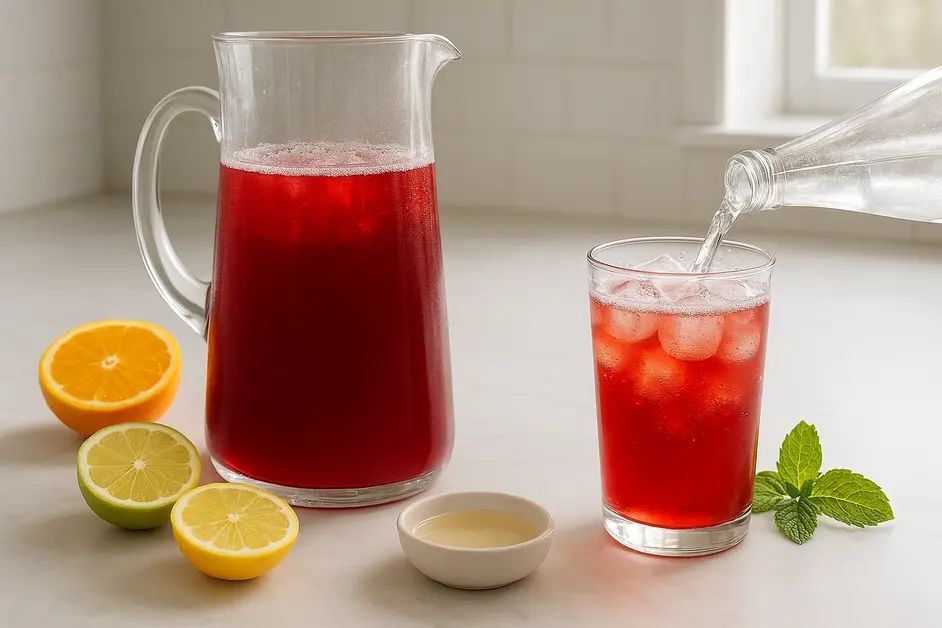
The workhorse ratio for sparkling party drinks is 4 cups base + 2 cups mixer, which yields eight 6-fluid-ounce drinks before ice. That’s 48 fluid ounces total, and it fits cleanly in a 2-quart pitcher for the still base. Once you know this ratio, you can turn almost any drink into a batch format—see these easy big batch cocktails for more starting points.
The 8-Drink Pitcher Method
This method works for both punch recipes and batch cocktails for parties:
- Build the still base. Combine 4 cups of the non-carbonated ingredients—juices, tea, puree, syrup, and spirits if using—in a 2-quart pitcher.
- Chill thoroughly. Refrigerate the base until cold so added ice doesn’t melt immediately.
- Keep bubbles separate. Hold the 2 cups of soda, tonic, sparkling water, or ginger beer aside.
- Pour 4 ounces of base into each 12-ounce glass, then top with about 2 ounces of mixer.
- Add ice and garnish at the moment of serving.
For mocktail-style self-service, the same structure applies at slightly different proportions: a 4-cup pitcher base divided into eight 4-ounce pours, topped with 2 fluid ounces of mixer per glass in a 12-ounce glass. Guests who prefer their drink still can skip the mixer entirely—which is exactly why keeping bubbles separate is worth the extra step.
Keeping Bubbles Separate for Freshness
Carbonation is fragile. Every time you stir a sparkling batch or let it sit in a pitcher, you lose fizz. Adding the mixer per glass means every pour is as lively as the first, and it gives guests control over strength and sweetness. This single habit solves two common batch problems at once: flat punch and drinks that are too strong or too sweet for some guests.
Glassware and Pitcher Selection
Match the vessel to the drink and the serving style. A 2-quart pitcher is the right size for one standard eight-drink batch. For guests pouring their own mocktails, 12-ounce glasses are the practical choice—large enough to hold 4 ounces of base, 2 ounces of mixer, and ice without crowding.
When choosing pitchers, prioritize a lid and handle for easy pouring and a capacity you can lift comfortably when full. Glass looks best on a display table; insulated pitchers help cold drinks stay cold longer, which matters if the station isn’t near a cooler.
For drink inspiration organized by spirit, classic cocktails like the Manhattan, Tom Collins, and Margarita translate well to pitcher format, while sangrias, mulled wine, and punches are batch drinks by nature. Fall-flavored options such as apple cider drinks, cranberry-orange punch, and mulled wine with oranges, cinnamon, and cloves are natural fits for autumn gatherings, and the same formats scale to any season.
Non-Alcoholic Party Drink Recipes and Mocktails
Mocktail recipes for parties deserve the same care as cocktails—proper ratios, real garnish, and a proper glass. These eight zero-proof bases are designed to be made ahead in a pitcher, portioned into glasses, and finished with a mixer of the guest’s choice.
- Strawberry Basil Lemonade — muddled or infused strawberry with fresh basil and lemon.
- Cucumber Mint Lime Cooler — crisp, cooling, and lightly tart.
- Hibiscus Orange Tea Spritz — tea-based, with a tart floral edge.
- Peach Ginger Iced Tea — sweet fruit balanced by ginger heat.
- Pineapple Limeade Base — bright and tropical.
- Watermelon Mint Agua Fresca — light and refreshing; a pinch of salt is used here as a flavor enhancer, not for hydration.
- Blueberry Lavender Lemonade — floral and berry-forward.
- Grapefruit Rosemary Sparkler — bitter-herbal, ideal for guests who dislike sweet drinks.
Batch mocktails guests can pour themselves follow the same make-ahead logic, so it’s worth comparing a few outside recipes against these bases when you want more variety.
Simple Syrup and Tea Preparation
Simple syrup is the backbone of most of these recipes and takes minutes to make: combine 1 cup water with 1 cup (200 g) granulated sugar and stir until dissolved. This yields about 1½ cups. Make it ahead and refrigerate—it keeps the prep work off your party-day list.
Tea-based mocktails need correct brewing to avoid bitterness. Use these guidelines, and check your tea package if it specifies otherwise:
- Black tea: one tea bag per cup of freshly boiling water, steep 4 minutes.
- Green tea: one bag per cup of water at 175°F (80°C), steep 3 minutes.
- Hibiscus or chamomile: one food-grade tea bag per cup of freshly boiling water, steep 5 minutes.
Note that culinary teas are used here for flavor, not as treatment doses. For low-sugar or keto-friendly versions, reduce or replace the simple syrup—but taste as you adjust, since sweetness also masks acidity and bitterness in these recipes.
Self-Serve Drink Station Setup and Presentation
A self-serve drink station is what lets you actually enjoy your own party. The goal is a layout where a guest who has never seen the setup can make a drink in under a minute without asking you anything.
Start with the furniture. Choose a table with adequate length and depth—a minimum depth of 16 inches gives you room to arrange bottles, ice, and glassware without crowding, which matters more than length when guests are reaching across the table.
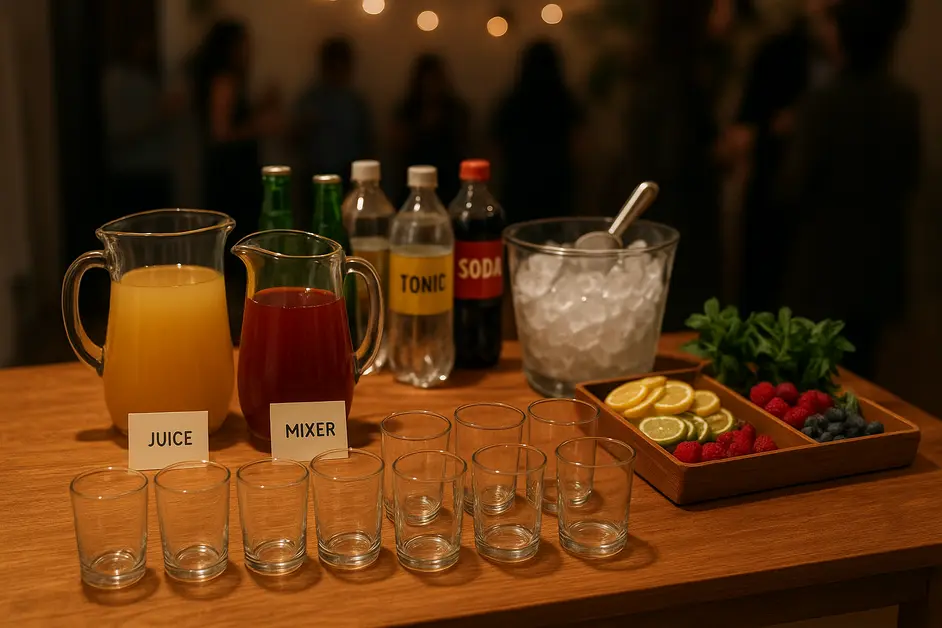
Then organize the station in the order a guest will use it:
- Glassware at the front edge, easiest to grab.
- Base pitchers (batched cocktails, punch, or mocktail bases), clearly labeled.
- Mixers and bubbles — soda, tonic, sparkling water, ginger beer—kept separate from the bases.
- Ice in a dedicated container with a scoop, never hands.
- Garnishes in trays or small bowls with small tongs or spoons.
- Labels on everything, including a note for which drinks contain alcohol.
Garnish Tray Ideas
Garnishes do more than decorate—they let guests customize. Useful options include fresh fruit slices (citrus wheels, berries, melon), citrus twists and peels, fresh herbs like mint, basil, and rosemary, and whole spices like cinnamon sticks for fall drinks. Label each ingredient so guests with allergies or preferences can choose confidently, and use separate utensils for each tray to avoid cross-contamination.
Keeping Drinks Cold Without Watering Them Down
Ice is the enemy of a good batch drink if it goes in too early. Chill your base thoroughly in the refrigerator beforehand, then set pitchers in an ice bath or use a cooler or insulated pitcher to hold temperature at the station. Add ice to individual glasses at serving time rather than to the pitcher, and consider frozen fruit as a garnish—it chills the drink without diluting it. If you’re serving from a large bowl, a block of ice melts more slowly than cubes.
Scalability and Batch Preparation Techniques
Scaling is where most hosts second-guess themselves, but the math is straightforward once you’re working from a ratio. The 4-cup base + 2-cup mixer formula yields eight 6-ounce drinks; to scale, multiply both parts together and keep them proportional.
| Target drinks | Still base | Mixer | Notes |
|---|---|---|---|
| 8 | 4 cups | 2 cups | Fits a 2-quart pitcher |
| 16 | 8 cups | 4 cups | Split across two pitchers |
| 24 | 12 cups | 6 cups | Two large pitchers; keep mixers separate |
| 32 | 16 cups | 8 cups | Use a punch bowl or cooler dispenser for the base |
Scaling Recipes Beyond Eight Drinks
The ratio holds at any size, but two adjustments matter as batches get larger. First, chill the base in multiple smaller containers rather than one enormous one—large volumes cool more slowly, and a warm base melts ice instantly. Second, taste before serving and adjust. Bigger batches amplify both sweetness and acidity, and fruit varies in ripeness and juice content. Have extra simple syrup, citrus juice, and mixer on hand so you can correct the balance at the last minute. For anything above 32 drinks, consider splitting into two different base flavors rather than one giant batch—variety handles a mixed crowd better than volume.
Make-Ahead Tips for Stress-Free Hosting
Work backward from your start time:
- Two to three days ahead: make simple syrup, brew and chill tea, and shop for fresh fruit and garnishes.
- One day ahead: build and refrigerate the still bases; wash and prep glassware; set up the station layout.
- Party day, morning: cut garnishes, set out trays, and chill mixers.
- Just before guests arrive: move bases into serving pitchers, fill the ice container, and finalize labels.
Troubleshooting Common Batch Issues
- Too sweet: add citrus juice or a splash of club soda; a pinch of salt can also temper sweetness.
- Too strong: increase mixer proportion per glass rather than diluting the whole pitcher.
- Too diluted or flat: you added ice or bubbles too early—start fresh with a chilled base and mix per glass.
- Flavors taste muddy: over-muddling herbs or over-steeping tea introduces bitterness; strain before batching.
Food Safety and Cold-Holding Guidelines for Party Drinks
Drinks sit out for hours, so treat them with the same care as perishable food. Keep cold items at 40°F (4°C) or below, and discard drinks after two cumulative hours without cold holding—or after one hour if the temperature is above 90°F (32°C). These are conservative household guidelines rather than validated shelf-life claims, but they’re the safe standard to follow.
Practical ways to stay within those limits: use ice baths, coolers, or insulated pitchers rather than leaving pitchers on a warm table; set a timer when drinks go out so you’re not counting hours from memory; and use clean utensils for each garnish tray to prevent cross-contamination. If you’re unsure how long a batch has been sitting, discard it—refilling is cheaper than a sick guest.
Food Pairings for Party Drinks
The general principle is contrast: sweet drinks pair well with salty or spicy foods, while acidic, citrusy drinks cut through fried or rich dishes. With that in mind, a few pairings that work reliably:
- Fruit and cheese boards suit nearly any drink category and double as a garnish source.
- Citrusy mocktails like cucumber mint lime cooler or grapefruit rosemary sparkler go with light appetizers—cucumber sandwiches, fresh berries, pasta salad.
- Spiced fall punches and sangrias stand up to hearty dishes like grilled skewers, tacos, or roasted meats.
- Creamy or sweet-leaning drinks pair well with lemon bars and fresh fruit.
- Spiced nuts and salty snacks balance sweet punches and cocktails.
For guests with dietary restrictions, keep pairings simple and label them: gluten-free options like fruit and cheese boards, grilled skewers, and fresh vegetables cover most needs, and vegetarian or vegan guests are usually well served by produce-forward appetizers. When in doubt, offer one clearly labeled gluten-free and one vegetarian option rather than trying to accommodate every possible restriction at once.
Seasonal and Themed Party Drink Ideas
The batch framework adapts to any season or theme—only the base ingredients change.
Fall: mulled wine served warm with oranges, cinnamon, and cloves; apple cider punch; cinnamon-ginger mocktails; apple-cranberry sangria with warming spice notes. Fall is also where savory spices bridge dessert and drink flavors, so cinnamon, clove, and apple work equally well in cocktails and zero-proof options.
Summer: watermelon mint agua fresca, berry sangria, and citrus coolers. Fresh fruit does the heavy lifting, and frozen fruit garnishes keep drinks cold without dilution.
Winter: hot toddies and Irish coffee are the classic warm options, with spiced punches for groups. Hot drinks suit an insulated carafe or slow cooker at the station, and guests can add their own spirit or keep it zero-proof.
Spring: floral mocktails, lavender lemonade, and herb-infused cocktails. Rosemary, basil, and mint are at their best here.
Themed parties: tropical cocktail ideas and piña colada-inspired batches suit island gatherings, while holiday parties lean on eggnog variations and spiced punch. If you’re adapting a themed drink, check current recipes for specific ratios—formats are flexible, but proportions aren’t.
Frequently Asked Questions
How many drinks per person should I plan for a party?
A common rule of thumb is two drinks per person in the first hour and one per hour after that. Adjust for weather, event length, and how many guests are drinking alcohol versus mocktails, and over-prepare the bases so you never run short.
Can I make party drinks ahead of time?
Yes. Batch the still base up to a day ahead and refrigerate it; keep carbonated mixers separate and add them per glass. Simple syrup and brewed tea can be made two to three days ahead and chilled.
How do I keep large batches of drinks cold without watering them down?
Chill the base thoroughly beforehand, hold pitchers in an ice bath or insulated container, and add ice to individual glasses rather than the pitcher. Frozen fruit works as a garnish and a slow-release chill.
What are the best non-alcoholic party drinks?
Strawberry Basil Lemonade, Cucumber Mint Lime Cooler, and Hibiscus Orange Tea Spritz are crowd-pleasers, along with watermelon mint agua fresca and pineapple limeade.
How do I set up a self-serve drink station?
Use a table at least 16 inches deep, and arrange it in guest-flow order: glassware, bases, mixers, ice, garnishes, and labels on everything—including which drinks contain alcohol.
What is the 4-cup base + 2-cup mixer ratio?
It yields eight 6-fluid-ounce drinks before ice. Scale both parts proportionally for larger groups.
How long can party drinks sit out safely?
Discard after two cumulative hours without cold holding, or one hour if the temperature is above 90°F (32°C). Keep cold drinks at 40°F (4°C) or below.
What food goes well with party drinks?
Fruit and cheese boards, grilled skewers, cucumber sandwiches, tacos, pasta salad, spiced nuts, lemon bars, and fresh berries all pair well and are easy to eat standing up.
How do I scale a cocktail recipe for 20 people?
Multiply the base and mixer proportionally—roughly 10 cups of base and 5 cups of mixer for 20 drinks—then chill in multiple containers and taste before serving.
What are some easy batch cocktail recipes for a party?
Sangria, pitcher margaritas, Moscow Mule batches, seasonal punches, and mulled wine are all naturally suited to batch preparation.
The Bottom Line
Party drink recipes work best when they’re built around a system rather than a single showpiece. Choose your bases with your guest list in mind—one or two spirits for drinkers, a genuinely appealing zero-proof option, and enough variety to satisfy a mixed crowd. Batch the still portions in advance, keep the bubbles separate until serving, and let guests pour their own. Chill everything properly, hold to the two-hour safety window, and pair drinks with simple, easy-to-eat food.
Do that, and the drinks stop being the task you’re stuck managing. They become one more thing your guests enjoy—and one less thing you have to think about once the doorbell rings.